Showing posts with label Kaiser. Show all posts

Monday, April 9, 2018

Badge-Engineering: 1947 Kaisers and Frazers

The end of World War 2 saw the emergence of several new automobile companies in the United States.  Even in those days when cars were much more simple than now, it still took a large amount of money to create a standard passenger car brand from scratch.  The Tucker was a famous failure, whereas Kaiser-Frazer, backed by famed industrialist Henry J. Kaiser, was somewhat successful, at one point capturing more than four percent of the American market before failing by the mid-1950s.  More information can be found starting here.

During the product development phase, front wheel drive was considered for the Kaiser brand.  But this was called off and Kaisers and the more up-scale Frazers shared the same 123.5-inch (3137 mm) wheelbase body.  Frazers had slightly more powerful motors and fancier interiors.  But exterior differences mostly had to do with grille design.

This is not full-fledged badge engineering, yet it comes fairly close to that.  Below are images of early (1947-1948) Kaisers and Frazers.

Gallery

A 1947 Kaiser publicity photo showing the simple, but rather awkward, design.

I include this idealized advertising illustration because it shows the Kaiser's grill design.  One inaccuracy is the raised area at the center -- behind it was body color painted sheet metal, and not a dark opening as shown.

Again, distorted illustrations typical of those times.  It shows the two brands' grilles for a quick comparison.  Note the chrome strip on the side of the Frazer as well as its more elaborate bumper design.

This Frazer publicity photo seems to show either a pre-production or perhaps an early production car.  That's because the grille lacks vertical bars typically seen on 1947-48 Frazers.  The bumper has only two guards instead of the usual four.

A "for sale" photo of a 1947 Frazer showing the grille and a two-tone paint job.  The radiator opening was the same as the Kaiser's and lacks the false grille opening segment mentioned above.
Read More

Monday, August 14, 2017

Kaiser's 1954 Darrin Sporty Car

As the 1940s were drawing to a close Americans were becoming sports car conscious, thanks to the affordable MG TCs being imported from England.  By the early 1950s, buyers might choose from the MG TD, Triumph TR2, Austin-Healey 100, Jaguar XK120 and others.

Seeing a growing market, some American companies developed and marketed what they called sports cars.  These usually were sporty cars with sports car looks, but lacking in sports car characteristics such as good handling.  They sold in low, sometimes hardly detectable, volumes, so their bodies were often made of fiberglass to save production costs.  I wrote about some of them here.  As it turned out, the only market success was the Chevrolet Corvette that remains in production more than 60 years later.

For this post, I deal in more detail with the 1954 Kaiser Darrin.  Its Wikipedia entry is here, and another fairly lengthy treatment is here.

I stand by the assessment I make in the post linked above, where I stated:

"Kaiser was on its way out as a mainstream manufacturer, so the Kaiser Darrin can be seen as one of the company's last-ditch dice rolls.  Darrin himself had been involved in custom coachbuilding for many years (think Hibbard & Darrin of Paris, late 1920s) and had been a styling consultant to Kaiser. The fiberglass-bodied Kaiser Darrin sat on a Henry J (compact Kaiser line) chassis and also hewed to the prevailing sports car fashion -- but with several distinctive twists.  Most obvious is the tiny grille that makes me wonder if the radiator was given as much cool air as it needed.  Then there are the sliding doors that, according to the [Wikipedia] link, proved troublesome.   The back fenders had a falling-to-the-rear shape that terminated in standard Kaiser sedan tail lights."

Gallery

Here is designer Dutch Darrin with the 1953 prototype.  Note the divided windshield with rounded top segments, a feature on Kaiser sedans.

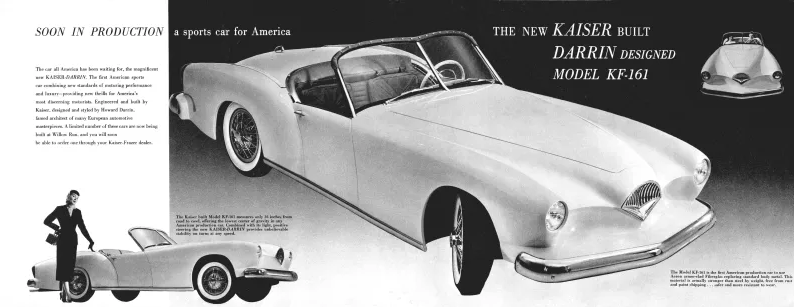
Publicity card announcing the Kaiser Darrin.  The prototype is shown,  Click to enlarge if you want to try reading the text (it'll still be very small).

This photo shows an event where the prototype is on display.

Publicity photo of a production Kaiser Darrin.  The windshield is now a one-piece affair.  This image and the one above illustrate how cramped Darrin's beloved sliding door openings were.

Auction photo (RM Sotheby's) showing the front and the small grille.  More air must have entered from below the bumper.

Side view of a Bonhams auction item.  The leading edge of the rear fender is aligned with the door cut line and seating.  This made production sense due to the sliding nature of the doors as well as probably simplifying the fiberglass moulds.  However, the resulting fender shape does not relate well to the rear wheel and its opening.

Same car, rear 3/4 view.  The trunk seems tiny, especially given that it would be the location of the spare tire.  Apparently Kaiser Darrins were intended for day trips, not long journeys.  The tail lights are those of 1952-53 Kaiser sedans.
Read More

Monday, February 27, 2017

Kaiser's Supercharged 1954 Facelift

Surprisingly often, failing automobile makers will market a strikingly facelifted or even completely new design as one last effort to prevent going out of business.  Examples include the 1936 Cord and the 1963 Studebaker Avanti. And so it was with Kaiser and its 1954 major facelift combined with adding a supercharger to its six-cylinder motor.

Kaisers entered the American market for the 1947 model year and were redsigned for 1951, both designs greatly influenced by custom car designer Howard A. "Dutch" Darrin (1897-1982), about whom here.

Head of Kaiser styling was Arnott "Buzz" Grisinger (1908-2002), obituary here, who worked at Chrysler during the 1930s and was at Ford during the last part of his career.  The 1954 facelift was created under his direction, but seems to have been influenced by Edgar Kaiser, president of the company.  I suspect that left alone, Grisinger might have come up with a different design.  In any event, the result was striking.  But the lack of a V-8 motor and public perception of Kaiser as moribund helped seal Kaiser's fate.  The 1954 model was the last U.S. Kaiser, though the brand carried on for a while in South America.

Gallery

This is a 1953 Kaiser that differed little from the 1951 redesign.

And here is a 1954 Kaiser Manhattan.

Close-up view of the restyled front end.  It resembles ...

... the 1951 Buick XP-300 dream car.  The XP-300 is far less known than the 1951 LeSabre, though both were developed and displayed around the same time.  Consumer Guide's book "Designing America's Car: The 50s" states that Edgar Kaiser liked the looks of the XP-300, so its concave grille with vertical bars and the headlight housings were adapted for the Kaiser.  Surely General Motors was not pleased.

Besides a new hood, fender fronts, grille and front bumper, other expensive changes included the greatly enlarged back window and rear bumper.  The redesigned tail lights were comparatively inexpensive, as they did not require heavy metal stamping.

Another rear view of the flashy '54 Kaiser Manhattan.

For some reason (perhaps unused body parts and window glass from 1953), entry-level Kaiser Specials retained the 1951-53 rear window.
Read More

Monday, February 6, 2017

Restyled 1951 Kaiser

A fine, but sadly largely overlooked 1950s American design was that of the 1951 Kaiser and its following two minor facelifts.  Some background on Kaiser is here and more details are here.

Kaiser reached production for the 1947 model year and ceased being sold in the USA after the 1954 model year.  There was only one redesign, that for 1951.  But that redesign was outstanding.  The man generally credited with it was Howard A. "Dutch" Darrin, who designed custom car bodies in Paris following the Great War. However, Kaiser-Frazer had some outstanding stylists on staff, and they helped refine Darrin's concept to its production reality.
Gallery

Here is an example of a 1948 Kaiser (Autotour blog image).  Darrin had a hand in this design as well, but the final result was heavy looking.  Nevertheless, it sold well at first due to the postwar demand for almost any kind of new car.

A page from Richard M. Langworth's 1975 book "The Last Onslaught on Detroit," a history of Kaiser-Frazer.  The upper image is of Darrin's design before it was refined for production.  Retained were the low hood and trunk lines, the "Darrin Dip" of the fender line and the tall, carved greenhouse profile.  Eliminating the Nash-like covered front wheels was a smart change, and the dog-leg rear door opening was another improvement.

This is the first of three Leake Auction Company photos of a 1951 Kaiser DeLuxe four-door sedan.  The greenhouse is proportionally tall, the main body is low by 1951 American standards.  The large windshield taxed glass-forming technology, so came in two pieces for that model year.

Side view.  The subtle trace of a rear fender gives the car an even lighter appearance.  That heavy chrome band along the lower part of the body offers some door protection while helping to further visually lower the car.  All this helps counteract all that sheet metal in the C-pillar zone.

Rear view showing how delicate the Kaiser's styling was.  The trunk was probably too small for some potential buyers.

Kaiser's 1952 facelift included a one-piece windshield and a bolder grille.  The V on the prow is deceptive, because Kaisers never had V-8 motors, a possible factor in the brand's demise.

1953 saw even more grille chrome, but still tastefully done.  Another change is the addition of little "wings" on the headlight housings.  This helped to subtly lower and widen the frontal appearance.  The thin chrome strip along the side marks this as an entry-level model -- top-of-the-line Kaisers retained the broad chrome band.
Read More