Showing posts with label Streetscapes. Show all posts

Thursday, April 19, 2018

Some 1939 United States Street and Parking Lot Photos

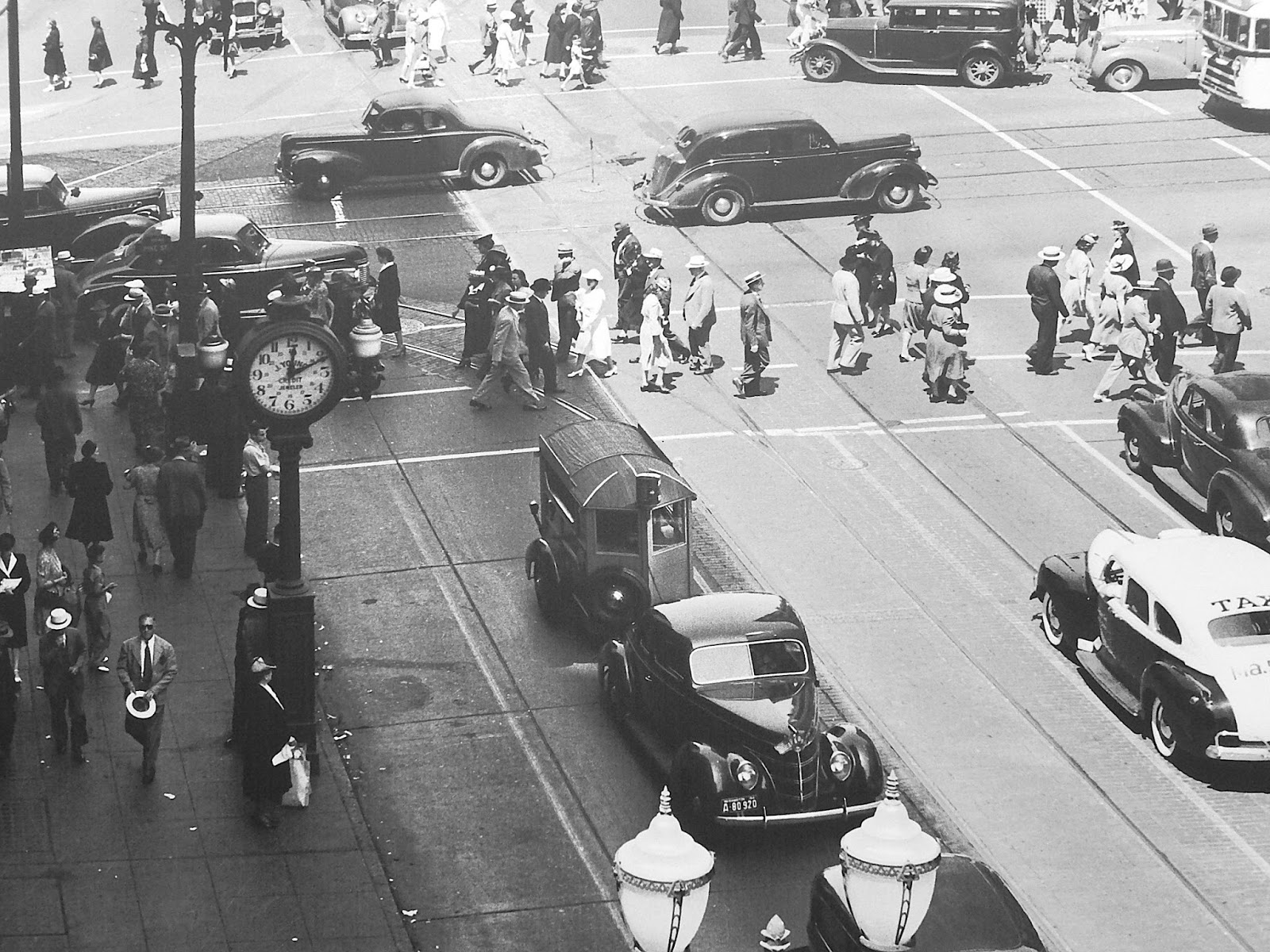
From time to time I need a break from discussing styling features.  For examples, last year I did this post about a photo of a major downtown Seattle intersection taken in the summer of 1942.

Now I'll present some 1939 views of streets and parking lots that I've gathered from here and there on the Internet.  Car-spotters should enjoy identifying various models.  History-minded viewers might simply enjoy these peeks into the past.

Click on the images to enlarge.

Gallery

Parking lot, Newport News, Virginia.

Parking lot for New York World's Fair.

Ford Pavilion roadway, New York World's Fair.

Wilshire Boulevard, Los Angles, looking west at Commonwealth.

New York: 34th Street near Fifth Avenue. This image will not enlarge much.

Sears rooftop parking lot, Los Angeles.

Sears rooftop parking lot, Los Angeles.
Read More

Thursday, March 23, 2017

Seattle Cars, Summer of 1942

This is another post in my occasional series showing historical views of cars in their native habitats.  An automobile's design is done in isolation (apart from analysis of competing designs), but in the real world cars are seen with others of different sources and model years.

(It needs to be added that during eras when car styles were either rapidly evolving or pushing off in odd directions -- from 1934 to 1962 or thereabouts in the USA -- stylists did have to pay attention to the degree to which drastically new themes would be acceptable to potential buyers.)

I photographed the images below from a fascinating (to me) photomural at a Seattle drugstore.  The setting is Seattle's main downtown intersection at the time (corner of 4th Avenue and Pike Street with Westlake Avenue branching off).  I like the scene for its large variety of cars and because it was photographed at a time where various brands could be identified.  That is, I find it difficult to identify brands in 1920s or earlier street scenes because the cars seem too similar: I'm basically a post-1930 car guy.

The mural caption states that it was taken in 1942, and it probably was.  But it might as well have been the summer of 1941 for several reasons.  The summer of 1942 was after the USA entered World War 2 in December of 1941.  By that time, car production had been curtailed and gasoline rationing was in place in Seattle by June of 1942, so traffic would be expected to be comparatively light, not so busy as the photo shows.  I see no military personnel, and some might have been evident were it 1942.  About half the license plates are 1941 plates (the dark ones) and half are 1942s which is a wash -- about the same would have been seen either summer.  Finally, I don't notice any 1942 model cars; the newest are '41 models.

That said, let's take a look.

Gallery


Two slightly cropped images of the photomural showing the setting.  They are fairly sharp, so you might try clicking on them to enlarge.  The remaining photos were zoom shots, and enlargements are uselessly blurry.

Queue of cars.  The fourth from the left in the near row is a 1941 Pontiac, helping to date the mural image.  Most of the other cars here are from the 1930s.  Second from the left in the near row is a 1937 Hudson.

The gray car by the crosswalk is a medium-price 1941 Packard, one of several Packards found in the mural.  The cars next to and following the Packard seem to be from the late 1920s.  At the top of this cluster is a dark 1941 Oldsmobile.

At the top is another late-20s car with its fixed sun visor and wood-spoked "artillery" wheels.  The car in the foreground might be a 1937 or '38 Dodge.

That large, two-toned car at the curb is a 1940 or possibly a 1941 Chrysler.  The taxi is a 1941 Dodge.

The Ford towing that odd looking trailer is a 1938 Ford Standard.  At the extreme left is another Packard.
Read More

Thursday, December 29, 2016

Streetscenes: Pre-Styling Days

The focus of this blog is the aesthetic appearance of automobiles.  For that reason, I seldom include more than one car in an image.  And in those comparatively rare cases, three cars is the usual maximum.

In the real world, especially on busy streets in large cities, one sees clumps of cars.  They are part of the environment, their styles contributing to the overall visual effect.

So, for a change of pace, below are some streetscape scenes photographed 1926-1930.  Few of the cars shown were designed by professional stylists.  They seem awkward to our eyes, and probably also would have to an observer in, say, 1940.  They reflect the automotive technological level of the 1920s, when most were built (some in the images might have rolled off the assembly line before then, but were still in use).  Perhaps the most striking thing I notice from photos taken from above pedestrian eye level is the cars' roofs.  For enclosed sedans, they are nearly flat and fabric-covered.

Here is a charcoal sketch, probably by Hugh Ferriss from the 1920s, showing a popular urban design concept of the time -- separated traffic and pedestrian levels.  Note the sea of cars depicted.  Also all those rectangular tops.  Less-exaggerated reality follows:

Gallery

Toronto: North from Queen & Yonge - 31 August 1929
All the cars heading toward us have exterior sun visors, a feature eliminated in the early 1930s when stylists began considering aerodynamics (albeit in a superficial way).

Chicago: Michigan Avenue - 1929
Interesting that there are no lane markers -- only a direction separation stripe.  That's the Tribune Building at the far right.

Los Angeles: Parade zone for Charles Lindbergh visit - 1927
Closed sedans are in the background, so all these open-top cars were probably to appear in the parade carrying dignitaries.

Los Angeles: Southern California Auto Club - 1926
South of downtown, just north of the University of Southern California campus.  Most cars seen here are from the late teens or early 20s.

New York City: Opening of the Holland Tunnel under the Hudson River to New Jersey - 1927
This comes fairly close to the charcoal sketch above.  Before the tunnel was built, cars had to be ferried across the river, so many New York and New Jersey drivers were highly excited and in a rush to give the more convenient tunnel a try.

Washington, DC: Gasoline station
A change of pace, tranquil scene.  I include it because it's in color.

London: Burney Streamliner - c. 1930
Well, not all cars in those days were boxy.
Read More