Showing posts with label Badge Engineering. Show all posts

Monday, April 30, 2018

Surprise Cygnet Sighting in Mayfair

A week and a half ago I was strolling along Curzon Street in London's posh Mayfair area on my way to visit the Duke of Wellington's Apsley House.

Mayfair is a great place for spotting expensive, exotic cars, so one would expect to spot a few Aston Martins.  But the one I spotted came as a total surprise.  Here is the photo I took (click to enlarge):


It happened to be an Aston Martin Cygnet from around 2012, a car that never got on my radar because they were not sold in the USA.

According to this Wikipedia entry (scroll down towards the bottom), Aston Martin wanted to lessen fuel efficiency penalties, so badge-engineered Toyota iQs (the main link subject).  The plan was to sell about 4,000 Cygnets a year, priority given to owners of Astons.  As it happened, only about 300 were made, half of which were sold in Britain.  So that car pictured above is a very rare young swan -- almost a black one ("black swan" reference here).
Read More

Thursday, April 26, 2018

Allstate, the Badge-Engineered Henry J

A nice example of 1950s American badge engineering is the 1952-53 Allstate.  As the link indicates, Kaiser wished to increase sales of its slow-selling compact Henry J brand by offering a faintly facelifted version for sale at the (in those days) dominant Sears-Roebuck department store chain.  What this means was that in a number of larger Sears stores there would be a small section with an Allstate car on display along with a sales desk.  By the way, for non-USA readers, the name "Allstate" is the name Sears uses for its insurance sales arm -- it was borrowed for naming the car.

Below are comparison images for Allstate and its host Henry J brand.

Gallery

You might want to click on this Allstate advertisement to enlarge it so that the smudgy text is faintly readable.

Publicity photo of a 1951 Henry J, the car's initial model year.  This design was carried over into 1952, but soon supplemented, as shown below.

Publicity photo of a 1952 Allstate.


This is a 2015 photo of mine of an Allstate taken at the National Automobile Museum (The Harrah Collection) in Reno.  That's a 1937 Cord 812 Beverly Sedan in the background.

Allstate grille.  Compare to the grille on the 1953 Henry J Corsair below.

"For sale" photo of a 1953 Henry J Corsair.  The Corsair model with the same grille design was introduced during the 1952 model year.  It has a cleaner, bolder design than that of the Allstate in the pervious photo.  Badge-engineering economy measures included the shared grille opening and the positioning of the turn-signal lights.

Bonus view: Allstate interior.
Read More

Monday, April 9, 2018

Badge-Engineering: 1947 Kaisers and Frazers

The end of World War 2 saw the emergence of several new automobile companies in the United States.  Even in those days when cars were much more simple than now, it still took a large amount of money to create a standard passenger car brand from scratch.  The Tucker was a famous failure, whereas Kaiser-Frazer, backed by famed industrialist Henry J. Kaiser, was somewhat successful, at one point capturing more than four percent of the American market before failing by the mid-1950s.  More information can be found starting here.

During the product development phase, front wheel drive was considered for the Kaiser brand.  But this was called off and Kaisers and the more up-scale Frazers shared the same 123.5-inch (3137 mm) wheelbase body.  Frazers had slightly more powerful motors and fancier interiors.  But exterior differences mostly had to do with grille design.

This is not full-fledged badge engineering, yet it comes fairly close to that.  Below are images of early (1947-1948) Kaisers and Frazers.

Gallery

A 1947 Kaiser publicity photo showing the simple, but rather awkward, design.

I include this idealized advertising illustration because it shows the Kaiser's grill design.  One inaccuracy is the raised area at the center -- behind it was body color painted sheet metal, and not a dark opening as shown.

Again, distorted illustrations typical of those times.  It shows the two brands' grilles for a quick comparison.  Note the chrome strip on the side of the Frazer as well as its more elaborate bumper design.

This Frazer publicity photo seems to show either a pre-production or perhaps an early production car.  That's because the grille lacks vertical bars typically seen on 1947-48 Frazers.  The bumper has only two guards instead of the usual four.

A "for sale" photo of a 1947 Frazer showing the grille and a two-tone paint job.  The radiator opening was the same as the Kaiser's and lacks the false grille opening segment mentioned above.
Read More

Thursday, March 29, 2018

Cute Neon

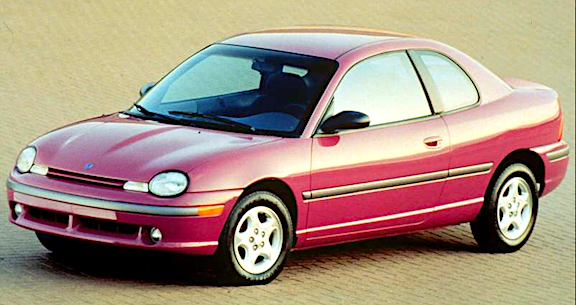
Chrysler produced a cute compact (in American terms) called the Neon over model years 1995-2005 with a body revision in model year 2000.  This is related by Wikipedia here.

Neons were a prime example of "badge engineering" whereby an automobile is marketed under two (or more) brand names with minimal differences.  In the Neon's case, those brands were Plymouth and Dodge in the USA, and overseas Neons were sold as Chryslers.  Basic first-generation Plymouth and Dodge Neons differed externally mostly via brand badges, though they also might have had different hub caps and other minor non- brand related items here and there.

Styling was of its time, featuring increased aerodynamic refinement compared to boxy Chrysler Corporation K cars that were marketed from the early 1980s into the 1995 model year.  Passenger compartment greenhouses were large and the rest of the bodies were comparatively short, features also in line with styling fashion in those days.  Ornamentation was minimal, this too a current practice.

The detail that made Neons seem "cute" and helped their marketplace success was the shape of their headlights and the smile-like effect of the lower air intake.  The story goes that Chrysler bean-counters objected to the headlight design on the basis of cost, wanting cheaper round ones.  This would have made Neons less distinctive and probably would have lessened sales.  Fortunately, the financial folks were overruled and Neons sold well, especially during the first model years.

The images below have captions based on what I found on the Internet: in many cases it's hard to tell if a Neon is a Plymouth or a Dodge when looking at a small photo.  Even the model years posted are problematical, though the Plymouth brand was dropped during 2001, so all USA Neons thereafter were Dodges.

Gallery

This is said to be a 1996 Plymouth Neon ...

... and this a 1996 Dodge Neon.  Two-door Neons such as this were produced only during the first generation.

1998 Dodge Neon showing rear-end styling.  First-generation Neons' front and rear bumpers and side trim had rub-strips at the same level, helping to integrate the design.

2001 Dodge Neon.  The general effect is quite similar to that of the first-generation design despite many detail differences.  The set of rub-strips mentioned in the previous caption is gone so far as bumper relationships are concerned.  The side strip has been joined by a character line above the door handles.  Headlights are a slightly different shape, but retain the "cute" theme of those on earlier Neons.

Rear 3/4 view of a 2003 Neon.  Different from before, but not seriously different.

Dodge Neon from late in the production run.  Its grille has been facelifted to incorporate Dodge's cross or "gunsight" theme that remains in place today.
Read More

Monday, April 3, 2017

A High Point in Platform-Based Brand Styling Variation

It costs huge amounts of money to develop a new automobile design.  For decades, manufacturers with more than one brand have been spreading those costs by using basic parts of the new body for various models of designated brands.

At one extreme, there is what is derisively called "badge engineering" where brands are differentiated by a small number of details such as brand badges.  The opposite extreme is the use of large amounts of differing sheet metal to give the basic body distinctly different appearances for each brand used.  A classic, successful instance of the latter was 1966-67 bodies on General Motors' E Platform.

The brands and models involved were the 1966 Buick Riviera, the 1966 Oldsmobile Toronado and the 1967 Cadillac Eldorado.  All were large, sporty coupes.  And they were made to look so different that casual observers were unlikely to realize that they shared a common platform.  Half a century ago, GM was rich enough to be able to do such things.

Gallery


From top to bottom are the Riviera, Toronado and Eldorado.  Similarities include the door cut lines, windshields, the tops as far back as the aft door cuts, and (to a large degree) the front and rear overhang.  Everything else seems different.


From the rear, there are no obviously shared parts.
Read More

Thursday, December 22, 2016

Some Badged First-Generation British Minis

Today's Mini brand is from BMW.  But the 1959 original Minis were products of BMC, the British Motor Corporation, that was the result of a merger of Austin and Morris. Some background is here and here.

The first Minis, produced 1959-1967, were the Morris Mini-Minor and the Austin Seven, the latter a long-time Austin model name.  Two years later, BMC launched Mini-based cars for two of its lesser brands.  These were the Riley Elf and Wolseley Hornet.

Although there may have been some mechanical differences between these various Mini-based brands, from a styling perspective it seems to have been a matter of what is called "badge engineering" -- cheaply implemented superficial differences intended to preserve brand identities.

The original Mini concept was successful in its day, but in the long run BMC, Austin, Morris, Riley and Wolseley all disappeared from the automotive scene.

Gallery

1962 Austin Mini-Cooper

1964 Morris Mini-Cooper
By far the most popular versions of British Minis were from Morris and Austin.

1961 Riley Elf
The Elf received a small bustle back and extended fenders.  The hood and lower front fender cuts lines are carried over from Morris and Austin.  A small version of a traditional Riley grille was added, along with "whisker" openings as part of the lower light ensemble.

Wolseley Hornet
Wolseley Hornets received treatments similar to the Elfs, the grille being characteristic of Wolseley.  One difference seen on the car illustrated here is the smoothed front fender -- the angled sheet metal join is missing.
Read More