Showing posts with label Plymouth. Show all posts

Thursday, May 24, 2018

1954 Plymouth Explorer Concept: Not by Exner

There is little Internet information regarding the 1954 Plymouth Explorer concept car.  Two snippets are here and here.  The second link mentions in passing that a Chrysler Corporation press release credited coachbuilder Ghia (which built the car) as being the designer, though the writer believed the designer was Virgil Exner (1909-1973) who was Chrysler's styling director and responsible for some previous Ghia-built show cars.

For a long time I too assumed that Exner and his team were responsible for most of those early-to-mid-1950s show cars, including the Explorer.  I got my information mostly from Motor Trend magazine in those days, but no longer have copies that might have dealt with the Explorer.

We now know that Ghia indeed designed as well as built a number of those cars, including the Explorer.  His Wikipedia entry credits Ghia owner Luigi Segre (1919-1963) with the design.  However, it seems to have been inspired by a previous Ghia product, the Fiat 8V Supersonic whose design is credited to Giovanni Savonuzzi.

The Plymouth Explorer still exists, and you can view it in Los Angeles at the Petersen Automotive Museum.  I saw it in the Spring of 2017 and took some photos displayed below.

Gallery
First, some early Plymouth Explorer photos:

The windshield might be a preview of Chrysler's 1955 version of the faddish mid-late '50s wraparounds.  Chrysler retained a backwards-sloping A-pillar, unlike most it its competitors.  The grille housing seems awkward seen from this angle.

Chrysler Corporation's brand having vertical grille bars was DeSoto, so the Explorer would better have been  given that label (though it was built on a Plymouth chassis and had a 6-cylinder motor instead of a DeSoto Firedome V-8).  The forward-leaning grille seems awkward from this perspective as well.

The substantial bumpers, especially at the rear, make the Explorer more street-worthy than most other show cars.
Now for my photos of the Explorer and the Fiat 8V Supersonic that also was on display.  Click on them to enlarge.

Front bumpers could not have protected the grille.


The tops of the rear fenders are oddly fussy.  These details and the grille mar an otherwise nice design on a comparatively large American platform.


The Fiat 8V Supersonic.  Similarities include the long hood, short passenger compartment and the raised, horizontal side trim and its air vent.
Read More

Thursday, March 29, 2018

Cute Neon

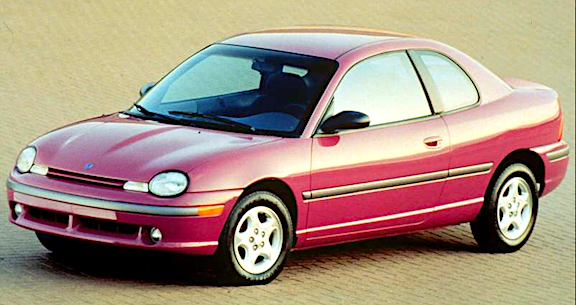
Chrysler produced a cute compact (in American terms) called the Neon over model years 1995-2005 with a body revision in model year 2000.  This is related by Wikipedia here.

Neons were a prime example of "badge engineering" whereby an automobile is marketed under two (or more) brand names with minimal differences.  In the Neon's case, those brands were Plymouth and Dodge in the USA, and overseas Neons were sold as Chryslers.  Basic first-generation Plymouth and Dodge Neons differed externally mostly via brand badges, though they also might have had different hub caps and other minor non- brand related items here and there.

Styling was of its time, featuring increased aerodynamic refinement compared to boxy Chrysler Corporation K cars that were marketed from the early 1980s into the 1995 model year.  Passenger compartment greenhouses were large and the rest of the bodies were comparatively short, features also in line with styling fashion in those days.  Ornamentation was minimal, this too a current practice.

The detail that made Neons seem "cute" and helped their marketplace success was the shape of their headlights and the smile-like effect of the lower air intake.  The story goes that Chrysler bean-counters objected to the headlight design on the basis of cost, wanting cheaper round ones.  This would have made Neons less distinctive and probably would have lessened sales.  Fortunately, the financial folks were overruled and Neons sold well, especially during the first model years.

The images below have captions based on what I found on the Internet: in many cases it's hard to tell if a Neon is a Plymouth or a Dodge when looking at a small photo.  Even the model years posted are problematical, though the Plymouth brand was dropped during 2001, so all USA Neons thereafter were Dodges.

Gallery

This is said to be a 1996 Plymouth Neon ...

... and this a 1996 Dodge Neon.  Two-door Neons such as this were produced only during the first generation.

1998 Dodge Neon showing rear-end styling.  First-generation Neons' front and rear bumpers and side trim had rub-strips at the same level, helping to integrate the design.

2001 Dodge Neon.  The general effect is quite similar to that of the first-generation design despite many detail differences.  The set of rub-strips mentioned in the previous caption is gone so far as bumper relationships are concerned.  The side strip has been joined by a character line above the door handles.  Headlights are a slightly different shape, but retain the "cute" theme of those on earlier Neons.

Rear 3/4 view of a 2003 Neon.  Different from before, but not seriously different.

Dodge Neon from late in the production run.  Its grille has been facelifted to incorporate Dodge's cross or "gunsight" theme that remains in place today.
Read More

Thursday, February 22, 2018

Chrysler's First Art & Colour Team's Results

By the 1920s when basic engineering requirements were largely in place, major American car makers began to shift attention to appearance as a sales tool.  At first they relied on designers in custom body firms and production body suppliers along with some of their own engineering staff who had an artistic bent.

In 1927 General Motors became the first large car manufacturer to establish an in-house styling section.  This was led by the now-legendary Harley Earl.  Chrysler Corporation soon followed suit.  In each case a few years lapsed before the work of these teams appeared on streets and roads.  This was because of lead-times from new concept to the market via the large amount of work required to engineer and productionize a new design.  Initial items effected by stylists usually were trim and detail changes.

This post treats the first results from Chrysler Corporation's styling group.  But first some background from the indispensable Lamm & Holls book, A Century of Automotive Style.

The authors point out (pages 153-54) that Chrysler set up a small styling section in July of 1928, calling it Art & Colour -- following General Motors' lead of the year before.  But this new unit was not nearly as independent as Harley Earl's, being under the control of Chrysler's mighty engineering staff.

"Among Art & Colour's staff members were Thomas (Tom) Martin, Herb Weissinger, A.B. (Buzz) Grisinger, Henry King, Rhys Miller, Max Wasserman, Bill Flajole, Ed Sheard, Gus Sompe and a handful of others; all young but highly enthusiastic and capable....

"For 1929-31, the Chrysler Imperial, along with Chrysler's four other lines, used what were called "ribbon" radiator grille shells. These looked like narrow chrome ribbons taped to the leading edge of the hood.  The idea was to make the hood look longer by making the grille shallower, but in actuality ribbon grilles made the entire front ensemble look weaker, cheaper and less substantial.  The public didn't like ribbon grilles, and yet they became something of a corporate identity symbol during those two to three years."

They go on to mention that 1931 Chryslers and Chrysler Imperials dropped the ribbon grille for a Weissinger design strongly inspired by Al Leamy's 1929 Cord design.

Here are examples of Chrysler Corporation cars from those days.  Dodge is not included because it was a long-established brand acquired by Chrysler in 1928 and not fully integrated with the rest of the Chrysler line until a few years later.

Gallery

1929 Chrysler Imperial with ribbon grille and Vauxhall-inspired hood scallops.  The 1930 models were little changed.

1931 Chrysler CG Imperial Close-Coupled Sedan,  RM Sotheby's photo.  Side window framing, the cowl shape and other details are carried over from previous model years.  What's new is the Cord-inspired grille design and revised hood.  The flat, split windshield was an Imperial oddity that detracted from the car's appearance.

1929 Chrysler 75 Tonneau Phaeton via RM Sotheby's.  Regular Chryslers lacked the Imperial's hood sculpting, but otherwise their front ends were similar for that model year.

1930 Chrysler 77 Dual-Cowl Phaeton by Locke, also actioned by RM Sotheby's.  This has Chrysler wings on the radiator cap ornament, but is essentially the same front as in 1929.

1931 Chrysler CM Roadster,  Hyman auction photo.  Now the grille is somewhat Cord-like.

1929 DeSoto Roadster with ribbon grille.

1930 DeSoto 4-door sedan.  Most '30 DeSotos lacked ribbon grilles, though Model K DeSotos retained them.

And then ribbon grilles returned across the board, as seen on this 1931 DeSoto 4-door sedan.

1932 DeSotos received grilles inspired by Miller racing cars.

1929 Plymouth Model U 4-door sedan,  Owls Head auction photo.  Chrysler's entry-level brand also got a variation on the ribbon grille where the framing was rounded.

1930 Plymouth 30-U 4-door sedan for sale.  The grille face is flatter than in '29, but the ribbon effect has been replaced by a conventional frame.

1931 Plymouth PA 4-door sedan, auction photo.  Again, no ribbon grille, and some rounding has returned.

From the images presented here, it seems that the ribbon grille situation by model year was more complex than how Lamm and Holls presented it.  Nevertheless, their thesis broadly holds in that the ribbon style was tried and then rejected.  Other design elements by the new Chrysler Corporation Art & Colour group are hard to detect besides the grille design borrowings from Cord and Miller.  This would begin to change for 1933 and 1934.
Read More

Monday, February 19, 2018

When Plymouth Lost Its Tail Fins

This post is a continuation of the theme of how Chrysler Corporation cars lost their 1950s tail fins.  I wrote about Dodge here, and now deal with Plymouth, Chrysler's entry-level brand.

One of the justifications for adding tail fins to cars was that for style and marketing reasons, their shapes could be fairly easily changed from model year to model year to keep designs seeming fresh and appealing.

Tail fins on passenger cars turned about to be yet another of those 1950s styling fads whose welcome soon wore out (others include three-tone paint schemes and panoramic windshields).

Here is the Plymouth tail fin story using the top-of-the line Fury 2-door hardtop as the example:

Gallery

1957 Plymouth Fury 2-door hardtop, Barrett-Jackson photo.  Plymouths were given tail fins for 1956, but these were tacked on to a fin-less 1955 design.  The new '57 Chrysler line designs incorporated tail fins from the start.

Same car, rear view.

1958 Plymouth Fury 2-door hardtop.  Plymouths were given a very light facelifting for '58.  Note the wide door cut lines on the car in this publicity photo.  Quality control was not a major priority in those days.

1959 Plymouth Fury 2-door hardtop, Mecum photo.  The final year of the '57 body received a stronger facelift, including larger tail fins.

1959 Plymouth Fury 2-door hardtop, rear.  The faux- spare tire cover on the trunk lid was borrowed from the 1951 Chrysler K-310 concept car.

1960 Plymouth Fury 2-door hardtop, Hyman Ltd. photo.  All Chrysler Corporation brands save Imperial were given new unitized bodies for 1960.  Plymouth's tail fin reverts back to the 1957 design theme.  The trunk lid of this car retains that faux- spare tire cover affectation.

1961 Plymouth Fury 2-door hardtop, cropped publicity image.  Tail fins were "plucked" as Chrysler styling chief Virgil Exner commented with respect to forthcoming 1962 designs.  Front end styling is awkward, fussy here, and the same can be said for 1960 Plymouths.

1961 Plymouth Fury 2-door hardtop, Mecum photo, rear.  More attractive than the frontal design, but the bumper needed to be set farther back to better protect the attractive overhanging trunk ensemble.  The rocket-ship tail lights are another example of 1950s styling theme overkill.

1961 Plymouth Fury 2-door hardtop, Barrett-Jackson photo.

1957 Plymouth Fury 2-door hardtop, Mecum photo.  These images illustrate how the 1957 and 1960 restylings differ.  For these 2-door hardtops, the most noticeable fundamental difference has to do with the passenger compartment greenhouse.
Read More

Monday, August 21, 2017

Plymouth's 1949 Fastback

During the late 1930s and early 1940s American car stylists tended to assume that future automobile designs would emphasize streamlining.  One aspect of streamlining as it was then understood was that it required the "fastback" style, where the roofline curved downward to the level of the rear bumper.

Chrysler Corporation and Ford Motor Company 1940 models featured fastback designs on sedans.  General Motors introduced especially sleek fastback bodies for 1941, but hedged its bet by retaining some mild bustle-back designs as well.

But by the time new post-World War 2 designs were planned, fastback styling was falling out of favor.  One likely reason was because bustle-back designs offered more trunk space, making them more practical.

Nearly all redesigned 1949 Chrysler Corporation cars had rectangular, bustle-back styling.  But there were two exceptions: entry-level Plymouth and Dodge 2-door sedans were fastbacks.

The Plymouth fastback is featured below.  All the photos are of cars listed for sale.

Gallery

This is a 1949 Plymouth Special DeLuxe 4-Door Sedan.  Most Plymouth sedans and coupes looked something like this.

Her is a 1949 Plymouth DeLuxe P-17 fastback.

1950 Plymouths were given a simplified grille, but otherwise little-changed.

One small change at the rear was different tail lights.

P-17 Plymouths had a 111-inch wheelbase, whereas other Plymouth sedans had wheelbases of 117 and 118.5 inches: this resulted in a stubbier look.  For what it's worth, this Plymouth did look sleeker than their 1940-48 fastbacks did.

Here is a 1949 Chevrolet Fleetline 2-door sedan.  It is far more stylish than the Plymouths shown above.  However, General Motors phased out fastback designs such as this after the 1952 model year due to slow sales.
Read More

Monday, July 24, 2017

Plymouth's Fins Final Fling: 1960 Fury

Chrysler Corporation's standard size cars mostly switched from body-on-frame to unitized construction for 1960.  Retained features included wraparound windshields with back-slanting A-pillars (first appearing in 1955) and tail fins (that began to sprout for the 1956 model year).

Virgil Exner was nominally in charge of Chrysler styling when the 1960 redesign was underway.  But he had suffered a major heart attack in 1956 that required open-heart surgery and a long recovery period.  Because of this, Exner was not deeply involved with the design of cars under development during the late 1950s, nor was he always pleased with the results of the work done by others.

The subject of this post is the 1960 Plymouth Fury, a car with odd design features.  Peter Grist, in his biography of Exner, has Cliff Voss responsible for its styling.  Voss was an experienced designer who had held leadership positions for years, so I find it a bit strange that Plymouths appeared the way they did.

As it happened, Plymouth sales were not good during the 1960 model year.  The 1961 facelift cleaned up the front end design somewhat, and tail fins were eliminated.

Gallery

Hyman Ltd. photo of a 1960 Plymouth Fury hardtop coupe.  The tail fins are unnecessary, the '61 facelift doing a neat job of replacing them with a sort of horizontal blade motif.  Otherwise, the design aft of the cowling is reasonably pleasing.

The major styling defect is the mess forward of the cowling, as seen in the previous photo as well as this Mecum Auctions image.  The worst detail is the curved chrome slash that whips around the front wheel opening while serving here as a paint tone separator.  The accent color forward of the opening serves to exaggerate the awkward, somewhat static zone in a design that otherwise flows tautly from front to rear (fins aside).  Quad headlights occupy too much space.  The "eyebrow" above the grille zone is too heavy-handed.  The shallow V at the lower edge of the grille clashes with the horizontal middle section of the eyebrow.  The nearly-horizontal connector bar between bumper side elements adds yet another shape that does not relate to its neighbors.

Side view of the same car.  From this perspective, the tail fins are clearly too large, and unbalance the design.

High angle view of the rear of a Fury convertible from Barrett-Jackson.  The fake spare tire cover is an affectation found on several 1950s vintage Imperials and then appeared on Furys for 1959.   This photo helps confirm that the fins are unhelpful from a design standpoint.
Read More

Monday, March 20, 2017

American Business Coupes

Wikipedia deals at some length here with the coupé (in America: coupe) body type.  A few lines of the link deal with the business coupe: "A coupé with no rear seat or a removable rear seat intended for traveling salespeople and other vendors who would be carrying their wares with them."

The American business coupe was part of the product mix for many brands from the late 1920s into the early 1950s.  Most were advertised as business coupes, but some coupes had more general names, yet could be used for business purposes.

The logic of using a coupe for traveling salesmen, consulting engineers and many other business activities requiring road travel was that coupes were: (1) usually inexpensive to buy; (2) had a usefully minimal seating capacity; and (3) had small cabins but also the long wheelbases of large-cabin cars so that there was room for a larger than normal trunk for carrying stuff.

Below are examples of this long-departed type of automobile body in chronological order.

Gallery

1929 Buick Master-Six Business Coupe
An early example.  The trunk is fairly small, so this body might also have had a rumble seat version.

1934 Hupmobile Aerodynamic Coupe
This is probably a rumble seat coupe.  I show it because of its very small cabin that seats two (or perhaps three in a pinch) and its long trunk area.  The rear-mounted spare tire would have made this an inconvenient business coupe because it would have interfered with loading.  A business coupe version would have been possible if the spare tire was repositioned.

1936 Oldsmobile Eight Business Coupe

1936 Buick Special Business Coupe
Two General Motors business coupes from mid-range marques.  I suppose these were offered for salesmen or business representatives requiring a more substantial image than that offered by entry-level brands.  The cars shown here used the same basic body.

1936 Packard One-Twenty Business Coupe
Another example of a mid-range business coupe.  Surprising, given that it was from the maker of luxury cars, but Packard had to enter a lesser market range in order to survive the Great Depression.

1937 Graham Cavalier Series 95 Business Coupe
A business coupe from a minor brand.  Note the illustration showing how the spare tire was stored, providing more convenient trunk space.

1939 Plymouth Business Coupe
A business coupe from Chrysler Corporation.  Like the Graham, it is a four-window coupe, something becoming common for business coupes by the late 1930s.

1939 Chevrolet Master Deluxe Business Coupe
This publicity photo shows a business coupe being loaded.

1939 Graham Combination Coupe
The text (click on the image to enlarge) mentions that a business version of this coupe was available.

1940 Chevrolet Master 85 Business Coupe
I include this brochure page image because it shows storage variations.

1941 Dodge Luxury Liner Deluxe Business Coupe
A nice example of a small cabin on a long-wheelbase car with the resulting large trunk.

1941 Oldsmobile Special Business Coupe
Yet another view of business coupe storage.

1949 Dodge Wayfarer Business Coupe
Business coupe production continued post- World War 2.  This one has Chrysler Corporation's redesigned postwar body style.

1951 Studebaker Champion Business Coupe - Mecum Auctions photo
Perhaps the flashiest business coupe of the lot, though that 1939 Graham comes close.  These small-cabin Studebakers have always fascinated me.

1950 Chevrolet Styline Business Coupe
Even General Motors continued business coupes into the early 1950s.

UPDATE: Further research shows that Chrysler Corporation's Plymouth brand offered business coupes as late as 1957.
Read More